
Preventive maintenance
Most equipment failures announce themselves before they happen: a drifting calibration, a blocked filter, a battery that no longer holds, a bearing that has started to sound wrong. A preventive visit finds those on a Tuesday morning instead of during a case.
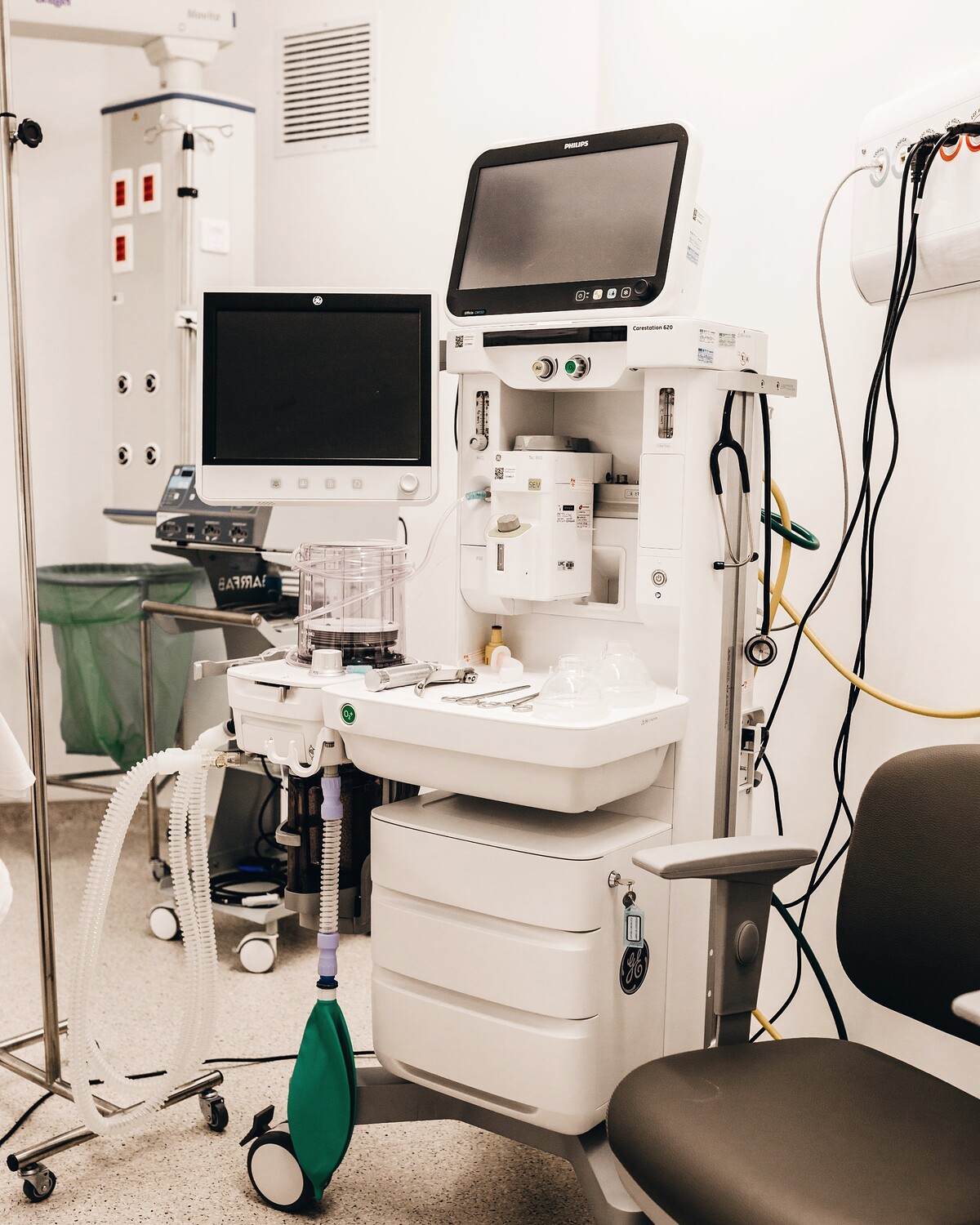
What a preventive visit covers
The checklist varies by machine. The structure does not.
- Electrical safety. Earth continuity, insulation resistance, leakage current, mains lead and plug
condition. This is the check that stops a fault becoming an incident.
- Function against specification. The machine is run and its output measured against its own
stated tolerance: delivered volume on a ventilator, flow rate on a pump, temperature and pressure on an autoclave, illumination and colour temperature on OT lighting.
- Wear items. Filters, seals, gaskets, tubing, valves, brushes, castors, bearings, hinges and
gas struts. Replaced on condition or on interval, whichever comes first.
- Battery condition. Load-tested, not just observed to charge. A defibrillator or a transport
monitor that fails on battery has failed at the only moment it mattered.
- Cleaning and decontamination of internals. Fan intakes, heat exchangers, condenser coils and
optical paths. Ahmedabad dust is a genuine cause of equipment failure and it is dealt with here.
- Software, alarms and settings. Alarm limits, default configurations, date and time on anything
that prints a record.
- User observations. The technician or sister who uses the machine daily is asked what it has been
doing. This finds intermittent faults that no test rig will reproduce.
Visit frequency
| Equipment | Interval | Why |
|---|---|---|
| Ventilators, anaesthesia workstations, defibrillators | Quarterly | Life support; failure has no acceptable window |
| Multipara monitors, infusion and syringe pumps | Quarterly | High unit count, continuous duty, battery-dependent |
| OT tables, OT lights, cautery, C-arm | Quarterly | Failure cancels a list; hydraulics and optics drift |
| X-ray, mammography, CT, ultrasound | Quarterly | Output accuracy is a patient-dose and diagnostic issue |
| Autoclaves and sterilisers | Quarterly | Pressure vessel; sterility assurance depends on the readings |
| Analysers, centrifuges, blood bank refrigerators | Half-yearly | Result validity and sample integrity |
| Ward, physiotherapy and furniture | Half-yearly | Wear-driven rather than performance-driven |
Manufacturer schedules take precedence where they specify a shorter interval. Equipment past its expected service life moves to a shorter interval rather than staying on the default.
The service report
Every visit produces a signed report per machine: what was checked, what was measured, what was replaced, and the condition the machine was left in. Every machine has a history sheet those reports accumulate into.
This is not paperwork for its own sake. It is what tells you, three years from now, whether a troublesome monitor has failed four times or once. It is what lets a biomedical department argue for replacement with evidence. And it is the first thing an assessor asks for.
Records at audit
NABH assessment and National Health Mission reporting both examine equipment maintenance records rather than equipment condition. An assessor wants to see a schedule, evidence the schedule was followed, calibration certificates in date, and a traceable history per machine.
Hospitals fail this section not because the equipment is poorly maintained but because nobody kept the records. Our documentation is built for that inspection from the start, and it is issued after each visit rather than assembled the week before an assessment.
Questions about preventive maintenance.
Not answered here? Call +91 98250 70790 and speak to someone who works on the equipment.
01How often should hospital equipment be serviced?
Life-support and imaging equipment quarterly. Operation theatre and sterilisation equipment quarterly to half-yearly. Laboratory and ward equipment half-yearly. Manufacturer schedules override these where they are stricter, and equipment past its expected life is moved to a shorter interval rather than left on the standard one.
02Does preventive maintenance actually reduce breakdowns?
It reduces the failures that come from wear, contamination, drift and depleted batteries, which is most of them. It does not prevent component failure, which is why a preventive schedule and a breakdown commitment belong in the same contract rather than being bought separately.
03Does the department have to stop work during a visit?
Individual machines are taken out of service for the time the checks take, generally twenty minutes to an hour. Visits are scheduled around theatre lists and ward rounds, and in ICU we work through the unit machine by machine rather than taking several offline together.
04What do we receive after each visit?
A signed service report per machine listing the checks performed, the readings taken, parts replaced and the condition on handover, plus a calibration certificate where calibration was carried out. All of it goes into the equipment history sheet for that machine.
05Can you take over maintenance of equipment that has never been serviced?
Yes, and it is common. The first visit is an assessment rather than a routine service. Existing faults are found, recorded and quoted separately, and the equipment enters the schedule from a known condition. Pretending an unmaintained fleet is in contract condition helps nobody.
Calibration
Discuss your equipment
requirements.
Contract quotations follow a precise site inspection and equipment audit, not a phone call. Contact us to schedule an assessment.
Head Office
11 Vrundavan Park, Sec 22Gandhinagar 382021
Gujarat, India
Workshop
A-207, Sumel Safal-6Dudheswar, Ahmedabad 380004
Gujarat, India